When I was in high school, I asked my Grandpa James Ruchti to share his World War II memories and experiences with me. I asked him initially for his thoughts for a school project for my US History class. However, the more I learned about his experiences, the more I became interested in the history of that time-period and the demands that the world put on the young men and women of that time. My Grandpa spent hours of his time committing his thoughts and memories to 180 minutes of cassette tape. Here is PART I of the transcripts of those tapes where he tells of his adventures in his own words. I hope that you enjoy learning about his experiences as much as I have! (Special Note: It was also wonderful to listen to his voice again after so many years as I listened to the tapes to transcribe them into this historical record to share with you!)
 |
| James Robert Ruchti, High School Yearbook Photograph, 1939 |
Part 1: Recollections of the Beginning of the War for the United States; Induction into the Army, Chanute Field, Illinois; Basic Training at Fort Knox, Kentucky; Artillery Meteorologist in Fort Sill, Oklahoma
Recording this tape on April 7, 1992. I have been asked by my granddaughter, Thomasin Clare Ruchti, to give her my recollections of World War II. This is a very timely request because 49 years ago yesterday, that is on April 6, 1943, I was inducted into the US Army after WWII had already begun. I was a student at the University of Wisconsin in my senior year, but I left before my final semester to enter the US Army as a member of the Army Enlisted Reserve Core. I was sent from my hometown of Janesville, Wisconsin to Chanute Field in Illinois, that’s down near St. Louis. There on April 7, I became a member of the US Army. I served in the army until the end of my terminal leave which was in May of 1946.
 |
| Chanute Field, Illinois, 1943 |
To fall back a few months before my induction into the army, to the day that the war began for the United States which was of course December 7, 1941, I was a student at the University of Wisconsin. December 7 was a Sunday. It was about 11 o’clock in the morning Madison Wisconsin time. I was in my dormitory room in Bashford House at Tripp Hall, and we were getting ready for Sunday dinner. In the hour or so before dinner I was doing some studying, and the news came through on the radio that the Japanese had attacked Pearl Harbor. That was a very large event. Not one that we had anticipated- that is those of us who were students at the university. Although we knew that the situation in Europe and in the Far East was getting more and more dicey. But after we had talked things over amongst ourselves over dinner that day and listened throughout the day for further news about the Japanese attack, we were notified by the radio and by the Daily Cardinal, the newspaper of the University of Wisconsin, that the next day there would be a meeting sponsored by the President of the University, Clarence Dykstra, to talk to the men, that is the men students who were very likely to be called up for military service in due course. President Dykstra had become the head of the selective service system. This was the system which drafted tongue men and accepted volunteers from women to serve in our armed forces during WWII.
I had no special feelings about the events of Dec 7, because not only were we surprised but the war in the Pacific and Hawaii seemed quite a bit away, a long distance away. Although we knew that an attack on US territory would certainly mean a declaration of war by President Franklin D. Roosevelt and the US Congress. And that indeed is what followed a few days later. And we all listened to the President's speech on the radio which was broadcast nationwide. And he said his famous words, “This is a day that will live in Infamy.” Of course the country was immediately united. Whereas in the months before Dec 7 there was a great deal of discussion about whether the United States should keep out of the war. The battles in Europe had been going on for some time, since Sept 1939 And the US political scene was very mixed. About half of the people did not wish the US to enter the war even on the side of allies and the democracies, which we all supported, because we thought that this was a battle that did not directly affect us. On the other hand there were any number of people, including students, who were more activist. They thought for sure that we would be drawn into the war sooner or later and it would be time for us to choose our allies and to work with them before it was too late and that Hitler and Japanese and Italian forces had gained a firm position which would make it more difficult for us to achieve victory. On Dec 7, even though the news was bad, there was absolutely no doubt in the minds of all of my friends, certainly in my mind, that the US would prevail in the war in which we were about to enter.
After the declaration of war on Dec 8, that is the US declaration of war against Japan and the Axis powers Germany, we of course immediately changed our entire focus of activity at the university. We knew that most of us would be called to serve or that we would volunteer to serve whether in the army or the navy. At that time there was no separate airforce. The airforce was part of the army. The navy had a separate air arm called the naval airforce. We all knew that we would be serving one way or another as we were called to do so and if we could pass the required mental and physical examination.
I became directly involved in the military effort long before I inducted into the army, actually 1.5 - 2 years later Dec, 1941 because the campuses of the United States, including the University of Wisconsin, became the scene of intense training activities using the facilities, and the faculty, and buildings of the university is including the dormitories to house the trainees that were sent. At the University of Wisconsin there was a large naval program and men and women both were sent as naval trainees to learn communications. They had to learn Morse code and how to send and receive messages. Of course this was a huge requirement and as the war developed it became clear that even the many hundreds that came to the University of Wisconsin campus in the year after Dec 7th of 1941 would never be sufficient to meet all of the needs. So there were training programs of a similar nature in other universities and other colleges. The universities offered a unique opportunity because of course they had the facilities, they were organized. They had the refectories which became mess halls. Also they had the gymnasiums which became physical training spots. They had the fields and the activity facilities where physical training could take place. And above all of course they had the highly trained faculty which could fit into just about any kind of circumstance that the military forces called on them to perform.
My job was a surprisingly lowly one up in the year after December 7. I worked in a laundry facility. This is the navy trainees, men, who were staying in Tripp Hall and so of course we were moved out. They had to have their laundry done. They had to have their uniforms spick and span at all times. And they would turn their, soiled uniforms over to a laundry facility which was run in one of the basements. We had a couple of students, I was one of them, who took in the laundry and sent it to the laundry [facility] with their names and tags and proper identification on it. Got it back. And then of course they had to pay us for it, which was a very nominal amount, but still we collected the money and therefore I was directly involved in doing navy laundry.
 |
| Fort Sill, Oklahoma, 1943 |
After April 7 1943, I was a young buck private. Course I was already a fairly old buck private. There were a lot of younger men who were 18, 19, 20 years of age. Eighteen was the minimum age you could serve, but I was born in 1921. So by the time I got into the army I was nearly 22 years of age. So I was not exactly a young, young private, but I was still a private and everybody's the same when they are of equal rank in the military services. My first job was to be transferred from Fort Chanute Field in Illinois to Kentucky. I went there to join a unit which was training men for the armored forces, that is tanks and self propelled artillery, armored personnel carriers. This was a base that's very famous for other reasons as well as it's armored forces, Fort Knox, Kentucky. That of course is where the US keeps its gold supply locked in a deep vault. (No I never saw the gold supply, Tommi, but I knew that it was there from my previous studies at the University.) There, I spent about 6 weeks in basic training which consisted of physical exercises, learning how to salute, learning how to march, learning how to clean my carbine which is a small shoulder weapon like a small rifle, and learning how to take care of my equipment and all of the things that soldiers have to learn no matter what unit they serve.
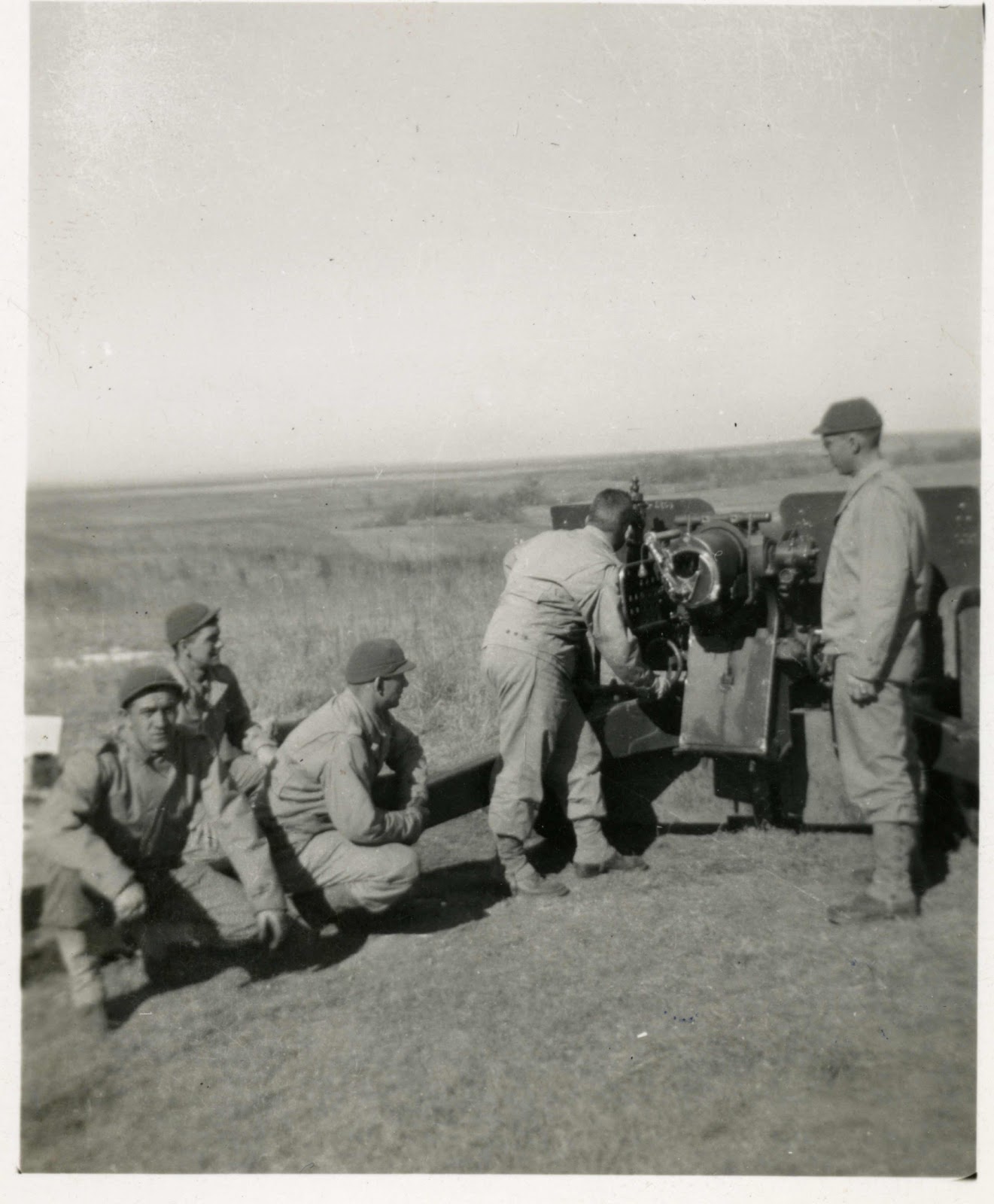 |
| Artillery Training with Howitzers at Ft. Sill, Oklahoma, 1943 |
But after a bit of time I was called into the orderly room which is the headquarters of the of the company where I was serving, and I was told that I was going to be transferred to Fort Sill, Oklahoma. So I never completed more than just a very elementary amount of armored forces training. I was sent to Fort Sill, Oklahoma for a most unusual reason. I had been trained when I was at the university under a military sponsored program to fly airplanes. I flew light aircraft, class one aircraft, and I had a private pilot’s license. Part of that training involved the study of meteorology because pilots have to know about weather. They have to know how to read weather maps and weather charts and to make calculations of weather that will affect their flying. Although I was wearing glasses by the time I finished university, and that was 2 years after I had received my pilots wings, I was therefore, as a wearer of glasses, not eligible to serve in the US army airforce. I was physically disqualified. But I had taken the meteorology, and meteorology is also important factor in the field artillery because they have to have what is called meteorological data, or MET data, to calculate the range and effects of weather on the large shells that are fired from heavy artillery pieces such as 155 MM guns, 8 millimeter howitzers, and those large weapons that have extreme long range. This MET data is collected by a special unit in the artillery and provided to the headquarters of the artillery in each major unit like a division of the army. And there it is disseminated to those people who need to know it. So I was trained to be a meteorologist, and I did that all during the summer of 1943.
The one event that I remember the most from that training was that on the day that my class of 1943 got its matriculation from the University of Wisconsin and was graduated from the university I was on KP, which stands for kitchen police. So I was peeling potatoes while my friends back at the university who had not yet been inducted were getting their diplomas. Course they mailed my diploma to me and eventually I got it in the mail. But it was quite a let-down not to be there with the rest of them. On the other hand it was very unrealistic to think that the US could continue to have nice little graduation ceremonies while there was a war going on and people were dying.
One of the reasons that I had been selected for the meteorology is because the numbers of men who had had any training in meteorology among the new inductees into the army was very few. So anyone who had those qualifications had it immediately noted by the personnel assignment people and then when they would go through the cards of each of us because they had no computers. But they went through the cards of each of the inductees and they would notice things like that that the army was looking for. That's how I happened to get into it.
One of the nice things about when I received my assignment was working on meteorology, a young lieutenant was assigned to our battery (in the artillery, a company is called a battery). He was assigned to our battery and his name was Newal Smith. Lieutenant Smith was the man who was the head waiter at the refectory at the University of Wisconsin where I worked when I was an undergraduate. That made it very nice for me and the other men in our MET section because I had a special friend who was an officer and that was very important for those of us because we had quite a few breaks from Lieutenant Smith. One day we were out on a training exercise. It was extremely hot. It was in July 1943. We were 2 or 3 miles from the nearest anything because we had been trained to disperse our trucks so that if there was an air attack from the enemy forces they wouldn't be able to get more than one of us. While we were dispersed, Smith drove up to inspect our unit to make sure we were doing our job. I got him aside for a moment and I said, “Newal, we are just dying of thirst out here. Can't we take a little break for a few minutes and get ourselves something to drink?” He agreed to that and so we drove into a nearby town which was about 4-5 miles away with our truck, went into a local drug store, and each had a Coca Cola. I have never in my life tasted a better Coca Cola!
How wonderful that you have your grandfather's recorded memories!
ReplyDelete